

Anonymous
A US snack manufacturer, known for its seasoned nuts, trail mixes, and candies in a hybrid relationship with Amazon (both Vendor and Seller Central).
The Challenge
For many ecommerce brands selling through Amazon Vendor Central, maintaining control over retail pricing can be one of the most challenging aspects of scaling on the platform. While Amazon provides unmatched distribution, its retail pricing algorithms often prioritize competitiveness and margin efficiency over brand strategy, often leading to unintended pricing outcomes that can negatively impact performance and long-term brand positioning.
In this case study, we explore how a fast-growing brand in the snacks category identified and resolved a critical pricing issue stemming from Amazon’s internal, automated pricing logic. By restructuring their product variation architecture, the brand was able to restore its intended pricing hierarchy, improve conversion rates, and significantly increase unit sales, all without relying on incremental traffic growth. More importantly, this case highlights how the catalog structure can influence Amazon’s algorithm, affecting everything from pricing to organic visibility to overall marketplace performance.
Challenge 1 (Retail Prices Above MSRP):
Challenge 2 (Rising Prices Driving Lower Conversion):
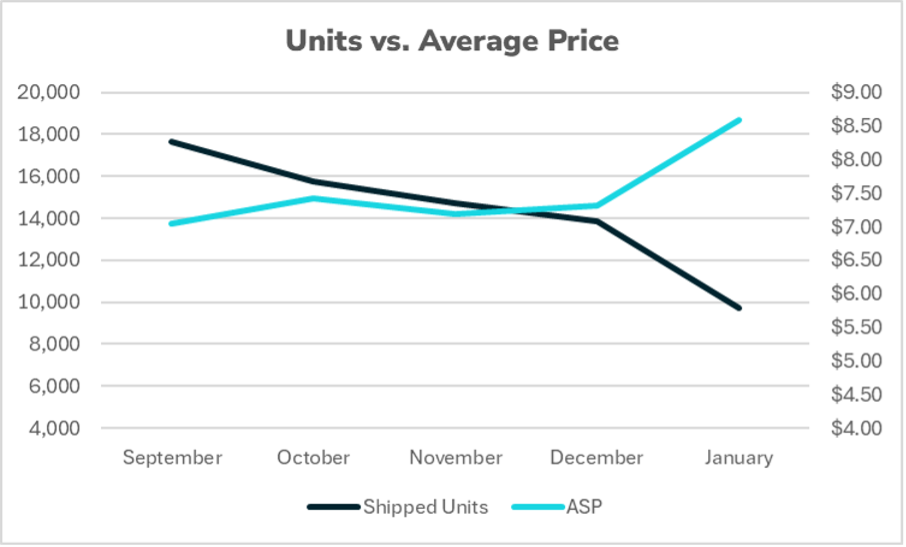
Given the price sensitivity of the trail mix, candy, and nuts subcategories, the impact of these increases was immediate. As ASP rose, unit sales began to decline. Customers who had previously viewed the brand as a strong value option were now encountering higher-than-expected prices, especially compared with similar products in their competitive set. This shift eroded perceived value and reduced purchase intent, particularly on high-traffic SKUs. As conversion rates declined, it became clear that pricing was affecting not only revenue but also the efficiency of the entire funnel.
The graph illustrates the inverse relationship between unit sales and average selling price for the brand’s top two products.
Challenge 3 (Declining Share of Voice):
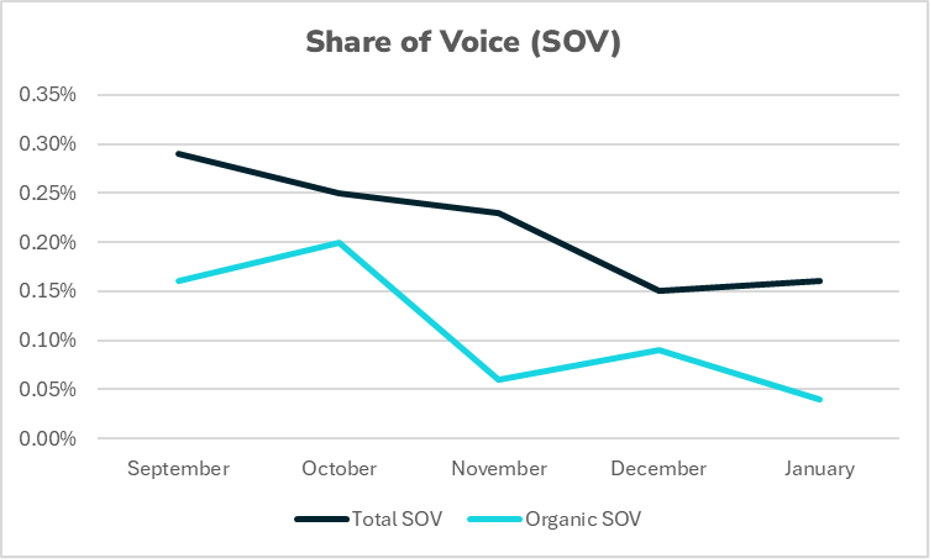
Despite maintaining a consistent advertising investment, with a slight seasonal spend increase during the key period of December, the brand continued to lose ground in overall share of voice.
As pricing continued to climb on the brand’s top SKUs, the underlying issue became clearer. Those higher price points were impacting conversion, particularly in a category where shoppers are highly price sensitive. Customers who once converted efficiently were now hesitating, either opting for lower-priced alternatives or dropping out of the funnel entirely.
Because Amazon’s algorithm heavily weights recent unit sales performance when determining organic rankings and placement, the reduced efficiency on top-performing SKUs quickly translated into lower visibility. Placements in search results that had once been consistently held, both organically and through advertising, became harder to maintain, further reducing the brand’s exposure to potential buyers and limiting its ability to compete for high-value search terms.
The Solutions
Solution 1 (Promotions):
Since brands do not have direct control over everyday retail pricing as Amazon Vendors, addressing pricing challenges required creative, indirect levers to influence Amazon’s pricing algorithm. One of the initial strategies the Hinge Commerce team attempted was running Best Deals promotions and coupons to influence ASP. The goal was to feed Amazon data indicating that a lower price drove an increase in unit sales. In practice, this tactic did succeed in temporarily decreasing the price of targeted SKUs, and for a brief period, conversion and unit velocity improved. However, the effect was short-lived: once the promotion ended, Amazon’s algorithm reverted prices to the previously elevated levels. This demonstrated that temporary price interventions could not reliably influence long-term retail pricing behavior or create sustainable improvements in sales velocity.
Solution 2 (Increased eCommerce Distribution):
Solution 3 (Variation Family Structure):
As the Hinge Commerce team continued to investigate other potential solutions, a deeper analysis revealed a more structural issue: Amazon was likely referencing the price per unit ($/unit) of other child variations under the same parent ASIN when determining retail pricing. This insight provided a new avenue to influence pricing indirectly by adjusting how products were organized in the catalog, rather than pursuing temporary promotions or distribution expansion.
| Product | ASP $/ounce | MSRP $/ounce | Difference (%) |
|---|---|---|---|
| 2oz, 12ct | $0.68 | $0.62 | +10% |
| 4oz, 12ct | $0.46 | $0.42 | +10% |
| 7.5oz, 6ct | $0.54 | $0.40 | +35% |
| 17oz | $0.52 | $0.41 |
+27%
|
| 48oz | $0.54 | $0.37 | +46% |
Based on the above, Hinge Commerce reorganized the variation structure. Instead of grouping all sizes within a single parent variation, we created separate parent variations by size tier while still including multiple flavors within each snack category. This allowed larger bags to exist within their own variation group, preventing Amazon from referencing smaller bag price-per-unit costs when calculating retail pricing within the parent/child variation structure. The change ensured that each size tier maintained its intended pricing hierarchy while aligning more closely with how customers evaluate value across pack sizes.
The redesigned variation structure was designed to restore the intended price-per-unit hierarchy, ensuring that larger bags retained their bulk-value advantage and remained an attractive option for customers looking to trade up. Beyond this primary objective, the new structure created an additional strategic benefit: it enabled us to run more precise, granular advertising campaigns, targeting customers based on the exact product type they were searching for. For example, by grouping all standard snack packs into their own variation, separate from the larger bags, our Retail Media team was able to optimize keyword targeting for end consumers with greater accuracy, ensuring that search queries aligned more closely with the right product size and type. This adjustment not only improved relevance in advertising placements but also increased the likelihood that customers would find exactly what they were looking for, creating a smoother path to purchase and improving overall conversion efficiency.
The Results
Once the new variation structure went live, the impact was immediate. Amazon Retail’s pricing algorithm quickly adjusted prices across the catalog, bringing retail prices back in line with the brand’s intended pricing hierarchy. For the first time in many months, the brand experienced steady, predictable pricing, which had several important implications beyond just unit cost. Stable pricing helps customers better understand the value of different size tiers, reinforces the brand’s positioning in the marketplace, and reduces the cognitive friction that arises when shoppers encounter fluctuating prices. This predictability strengthens purchase intent, encourages trade-up behavior, and makes it easier for advertising campaigns to confidently target the right products.
From an Amazon strategy perspective, consistent pricing also improves the algorithm’s performance evaluation over time. When pricing volatility is reduced, conversion rates stabilize, enabling stronger and more consistent sales velocity signals. This, in turn, supports improved organic rankings, better placement across search results, and more efficient paid media performance. In other words, steady pricing not only supports the customer experience but also enhances long-term marketplace visibility and share of voice.
When comparing the 30 days following the variation changes to the previous 30-day period, the brand saw significant improvements across all key retail metrics, demonstrating the effectiveness of this structural approach:

Average Selling Price (ASP): The ASP decreased by 11%, bringing prices closer to the levels the brand had intended. By realigning with target pricing, customers could once again perceive larger bags as offering true bulk value, restoring the incentives for upsizing purchases. This alignment also helped stabilize revenue per unit, making pricing decisions predictable for both the brand and its consumers.

Conversion Rate: Conversion rate increased by 23%, reflecting a meaningful improvement in purchase efficiency. This improvement indicates that customers were responding positively to the restored price-per-unit hierarchy, perceiving the value of larger packs compared to smaller sizes. Additionally, the Ads Conversion Rate improved, contributing to a reduction in ACoS (Advertising Cost of Sales) and more efficient use of advertising spend. The combination of steady pricing and relevant advertising placements created a virtuous cycle: higher conversion rates drove improved sales performance, which in turn further reinforced algorithmic rankings.

Unit Sales: Unit sales rose by 26%, reflecting stronger sales velocity across both top-performing SKUs and other products within the catalog. By restoring clear value propositions through pricing and variation adjustments, the brand encouraged customers to purchase larger sizes, trade up when appropriate, and feel confident in their buying decisions. These gains in unit sales demonstrate that structural changes can drive growth even without additional traffic.