How Rufus (and the Next Wave of AI Shopping Assistants) Are Changing Amazon Discovery
AI-driven shopping assistants aren’t coming; they’re already here. Amazon’s Rufus is reshaping how customers discover, evaluate, and choose products, shifting search away from simple keywords and toward real, conversational intent.
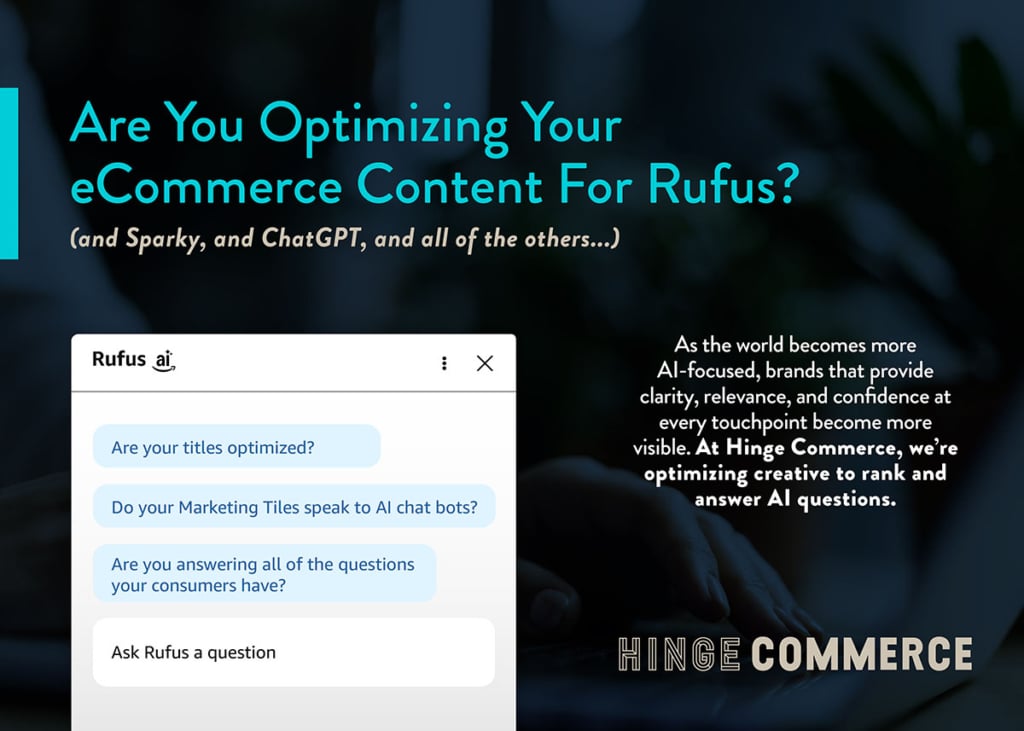
At Hinge Commerce, we’re optimizing creative to rank and answer AI questions. As the world becomes more AI-focused, brands that provide clarity, relevance, and confidence at every touchpoint become more visible.
And Rufus is just the beginning.
From Keywords to Conversations
Traditional Amazon optimizations focused heavily on keyword density and backend search terms. While these things still matter, Rufus introduces a new layer: answering shopper questions.
“What’s the difference between this and the previous model?”
“Is this safe for sensitive skin?”
“How easy is this to install or use?”
Rufus surfaces these questions directly in the shopping experience and uses your listing content to answer them. That’s why our approach starts with intent-driven insights.
Intent-Driven Insights: Designing Listings Around Real Questions
Rufus reveals what shoppers are asking about your product. We analyze those questions to understand not just what shoppers want, but why they’re hesitating, comparing, or ready to convert.
We use this intelligence to shape:
- Titles that immediately establish relevance
- Bullet points that eliminate uncertainty
- Visuals that reinforce answers without adding friction
The goal is to create more useful conversation based content.
Keyword + Intent Pairing: Ranking with Purpose
AI assistants don’t replace SEO; they raise the bar for it.
We pair high-value keywords with clear shopper intent to ensure listings:
- Rank for competitive search terms
- Align with how shoppers phrase questions in AI-driven discovery
- Maintain relevance across both traditional search and AI summaries
Whether a shopper is typing a query or asking Rufus for advice, this balance ensures your product shows up and resonates.

An FAQ-First Approach to Conversion
One of the biggest advantages of Rufus is its clear highlighting of recurring consumer questions. We treat these questions as a roadmap.
Our FAQ-first mindset influences:
- Bullet structure and sequencing
- Product descriptions that scan cleanly
- Marketing tiles that reinforce key answers visually
- Below-the-fold content that supports deeper consideration
By proactively answering questions, we reduce confusion, shorten decision cycles, and increase conversion confidence.
Optimizing Every Creative Surface on Amazon
AI doesn’t just read your copy; it interprets your entire product ecosystem. That’s why we optimize holistically across:
Titles & Bullets
Clear hierarchy, immediate relevance, and intent-led messaging.
Product Descriptions
Structured for readability and AI comprehension, not keyword stuffing.
Marketing Tiles & Imagery
Designing visuals to answer the top questions Rufus surfaces.
A+/EBC & Brand Story
Used to reinforce differentiation, brand authority, and long-term trust signals.
Amazon Storefronts
Built as navigable brand ecosystems that support AI-driven exploration and cross-product discovery.
Every surface contributes to how AI understands and represents your product.
One Source of Truth: Accuracy Wins in AI Search
AI assistants pull from multiple data points. Inconsistent or outdated product information leads to inaccurate answers, misrepresentation, and lost trust.
We emphasize centralized, accurate product data so AI tools like Rufus, Walmart’s Sparky, and even ChatGPT can confidently surface the right information to shoppers.
In AI-driven commerce, accuracy is a growth lever.
Continuous Refinement in a Constantly Evolving Landscape
AI search is not static, and neither is our optimization strategy.
We continuously monitor:
- How Rufus presents your product versus competitors
- How Sparky frames similar SKUs on Walmart
- How AI shopper assistants describe features, benefits, and use cases
This allows us to refine positioning, strengthen differentiation, and identify cross-sell opportunities as AI-driven discovery evolves.
Relevance isn’t a one-time optimization; it’s an ongoing discipline.
Looking Beyond Amazon: Optimizing for the AI Shopping Ecosystem
While Rufus is our primary focus today, shoppers are increasingly turning to:
- ChatGPT for product recommendations and comparisons
- Walmart’s Sparky for guided discovery
- Other emerging AI shopping assistants across retail platforms
Our creative strategy is designed to scale across these ecosystems so your brand stays visible wherever shoppers ask questions next.
Final Thought: The Brands That Win Will Be the Ones That Answer Best
AI search rewards clarity, relevance, and confidence. Brands that adapt their creative to speak directly to shopper intent won’t just keep up, they’ll lead the pack.
At Hinge Commerce, we help brands stay ahead by optimizing creative for how people actually shop today and how AI will shape commerce tomorrow.