

The eCommerce landscape is experiencing an unprecedented paradigm shift. For over a decade, brands have operated under a relatively predictable playbook: optimize for keywords, climb the Search Engine Results Page (SERP), capture click-throughs, and convert traffic through persuasive product copy. Traditional, keyword-stuffed SEO was the undisputed gatekeeper of digital commerce.
We have officially entered a new era: the age of Agentic Search.
With advanced AI agents moving rapidly from passive search assistants to proactive, autonomous shoppers, the core mechanics of online visibility have changed. Industry data highlights how fast the ground is shifting: recent projections from Gartner reveal that brands will see their organic search traffic decrease by 50% or more as consumers embrace AI-backed search results*. This shift is proven by the evolution of marketplace AI tools. This transformation is already visible in the evolution of Amazon’s AI-powered shopping experience:
- Rufus has evolved from a standalone conversational shopping tool into a core part of Amazon’s broader AI ecosystem.
- Amazon has integrated Rufus into Alexa, creating a unified shopping assistant across Echo devices, the Amazon app, and Fire tablets.
- AI is now influencing product discovery before shoppers even view search results, with Alexa-generated prompts appearing directly within the search experience.
Search is splitting. For every headline championing the rise of AI agents, consumers are still actively using traditional search results. More importantly, AI search experiences are built upon the very content, signals, and rankings that power those traditional SERPs.
At Hinge Commerce, we don’t just passively adapt to this shifting terrain; we architect the content that defines it. Winning in this environment requires a profound understanding of how AI logic intersects with human intent. Here is an in-depth breakdown of how we build flexible, future-proof product content structures designed to satisfy the world’s most sophisticated AI models while turning algorithmic visibility into lasting brand loyalty.
1. Mastering the Shift: From Contextual to Agentic Search
To understand how to win today, brands must first understand what AI agents are actually looking for. Traditional SEO relies on exact text matching. If a consumer searches for “ergonomic office chair with lumbar support,” older search algorithms look for listings containing that exact string of text.
Agentic Search operations are completely different. When a shopper asks Alexa to find the best seating solution for chronic lower back pain, the AI agent doesn’t just search for a keyword string. It acts as an autonomous representative for the buyer. It synthesizes consumer reviews, analyzes product specs, evaluates real-world compatibility, and uses complex logical models to select the absolute best match.
![[Traditional Search] ➔ Keyword Matching ➔ Simple List of Links
[Agentic Search] ➔ Semantic Reasoning & Problem Solving ➔ Direct Answer/Autonomous Purchase](https://hingecommerce.com/wp-content/uploads/2026/06/Beyond-the-Search-Bar-Mastering-Agentic-Commerce-with-Hinge-Commerce_BlogLayout_02_Traditional-vs-Agentic-1024x368.jpg)
Because of this, brands must pivot from a pure SEO-based strategy to include a highly intentional Conversational Shopping Approach. To speak directly to these advanced AI models, Hinge Commerce builds deep, structured context into the exact areas we know these digital agents scrape for data.
Categorizing the Scraping Architecture
A recent benchmark study from Mirakl utilizing their Generative Engine Optimization (GEO) Readiness Analyzer revealed a startling reality: less than 1% of product pages currently meet the minimum standards for LLM recommendation, primarily due to missing machine-readable structured data. At Hinge Commerce, we close these gaps by dividing our optimization pipeline into two distinct algorithmic target zones:
- Primary AI Scraping Fields: The Title, Bullet Points, and Backend Keywords hold the highest mathematical weight for an agent’s initial retrieval phase. If the foundational logic isn’t present here, the AI agent will overlook the listing entirely.
- Contextual Visual & Technical Fields: Marketing Tiles, Product Descriptions, Enhanced Brand Content, and Alt Text serve as the deep training ground where the AI verifies its findings, reads image metadata, and builds confidence in its recommendation.
2. Writing to the COSMO (Common Sense Modeling) Framework
How do AI models like Alexa determine if a product is truly relevant to an autonomous buyer? They rely heavily on COSMO (Common Sense Modeling). COSMO is an algorithmic framework that attempts to replicate human common sense by analyzing the relationships between users, queries, use cases, and product features.
Instead of asking, “Does this listing have the keyword?” the AI asks, “Does this product make logical sense for the user’s life scenario?”
At Hinge Commerce, we write and design every single marketplace listing to directly satisfy the three core pillars of COSMO:

Pillar 1: Who does this product serve? We inject extreme audience specificity into the copy. We don’t just state what the product is, we explicitly outline the demographic, lifestyle, or professional profile of the ideal user. This allows an AI agent to instantly match a user’s profile with your product profile.

Pillar 2: What problem does it solve? AI agents are fundamentally problem-solvers. If a consumer presents a pain point to Alexa, the agent searches for a product whose content explicitly details a solution. We frame features as direct resolutions to specific, real-world problems.

Pillar 3: What products are compatible? Agentic tools are highly focused on ecosystems. Whether it is a software integration, a physical attachment, a specific dietary restriction, or a complementary household appliance, we explicitly outline product compatibility. This ensures your product is surfaced during multi-item or complex system queries.
By maintaining absolute specificity and ensuring contextual completeness, we turn your product listings into the definitive answer to an agent’s logical query.
3. Continuing to Tell the Full Product Story
While optimizing for AI logic is non-negotiable, a critical trap many brands fall into is forgetting the human on the other side of the screen. An AI agent might surface your product as the number-one recommendation, but in most transactions, a human consumer still reviews the selection before hitting “add to cart.” If they arrive at a page that reads like a broken, robotic piece of code, they will bounce.
Our methodology relies heavily on Structured Product Knowledge. We ensure that your brand’s unique voice, emotional resonance, and visual identity are never lost in translation. We approach this through a balanced text architecture:
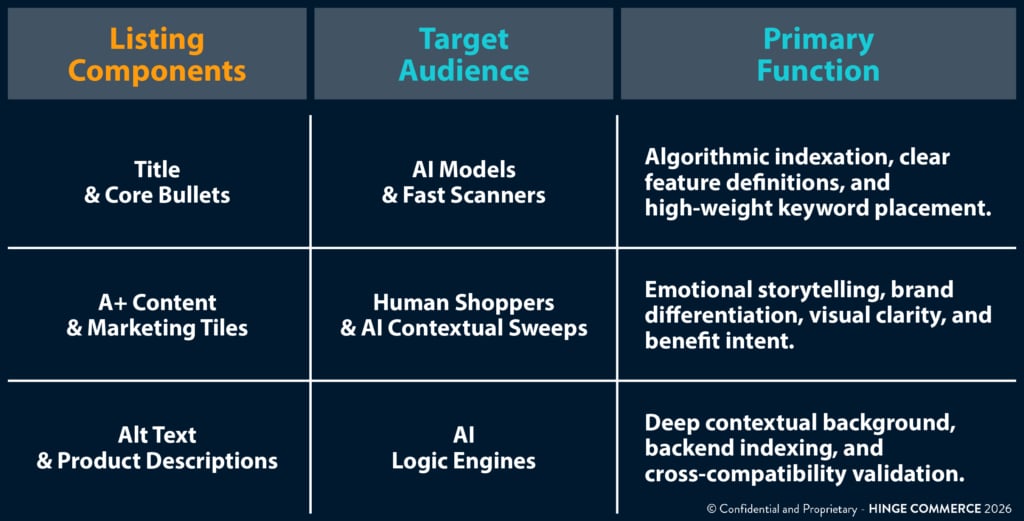
By separating these responsibilities across the detail page, we ensure that a machine-optimized listing remains an incredibly persuasive, beautifully designed storefront for the human consumer.
4. Engineering the Path to Purchase
Achieving compounding marketplace growth requires a highly deliberate, streamlined optimization pipeline. We do the complex work of aligning AI logic with human-centered design, systematically moving the consumer and their AI agent from discovery to conversion across five critical phases:

Step 1: Tailor Content for Agentic Search
We structure product data explicitly for conversational AI, embedding the specific semantic phrases and common-sense answers that engines like Alexa prioritize.

Step 2: Win Algorithmic Visibility Across AI & SERPs
By merging traditional SEO best practices with data structured specifically for AI models, your products achieve top-tier placement. Because traditional SERPs serve as the foundational bedrock for AI data-scraping, this dual approach ensures your brand stays visible across standard search queries, voice search results, and automated shopping carts.

Step 3: Drive Higher Click-Throughs
By aligning the initial search intent perfectly with the visual assets shown on the SERP, the dynamic, AI-curated interface that replaces traditional search pages, we maximize the volume of qualified traffic landing on the product detail page.

Step 4: Design for Key Benefit Intent and Human Experience
Once traffic arrives, we deliver relevant, human-centered experiences. We place the most important consumer benefits in high-visibility areas, matching the specific reasons a consumer wants to buy with immediate visual confirmation, lifestyle imagery, and clear brand narratives.

Step 5: Build Brand Trust and Confident Decision-Making
When a product page answers every question an omnichannel shopper has, without making them dig through a wall of text, it builds massive brand equity. The consumer feels confident in their choice, drastically reducing cart abandonment.
5. The Formula for Compounding Revenue
Marketplace success is not driven by a single isolated metric. It is the result of multiple conversion vectors working together in perfect harmony. To understand exactly how retail algorithms and human behavior interact to drive compounding growth, we utilize a direct, performance-focused conversion equation:
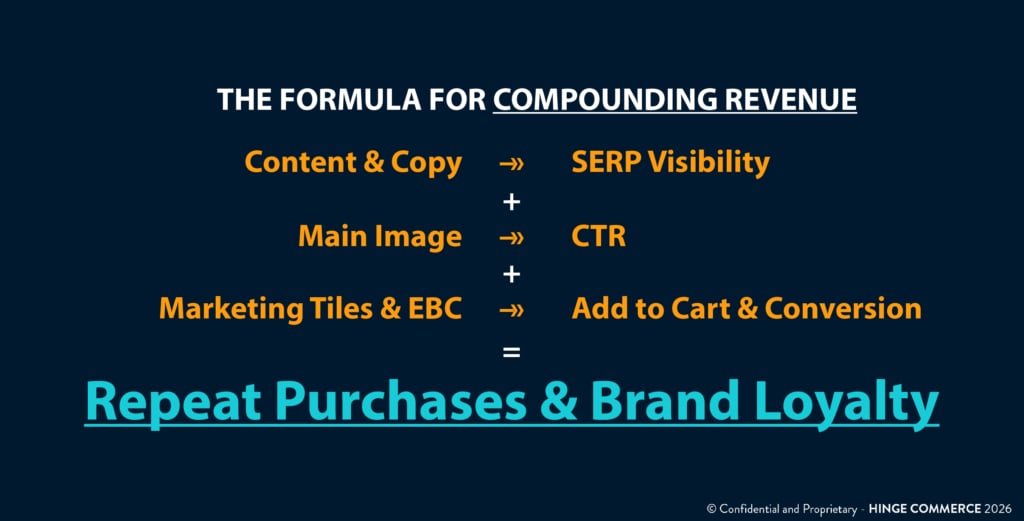
This conversion equation forms the core of our creative and analytical philosophy. By eliminating friction at every single touchpoint, we turn standard algorithmic traffic directly into sustainable, predictable brand equity.
6. The Hinge Advantage: Future-Proof Agility for Continuous Growth
The defining characteristic of the Agentic Commerce era is its sheer velocity. Algorithmic weights change overnight, retailer compliance rules shift without warning, and a rigid, static content strategy will quickly make your products invisible to autonomous AI shoppers.
Hinge Commerce is built to solve this exact problem. We don’t just launch assets, we provide a fluid, living content pipeline designed to react instantly to marketplace disruptions:
- Rapid Copy Adaptability: When search priorities rapidly migrate, like the shift from Rufus to Alexa, our teams pivot asset frameworks immediately to feed the dominant algorithm.
- Dynamic Keyword Re-weighting: We continuously track where AI models scrape data, shifting critical keywords between titles, bullets, and backend terms in real time.
- Scalable Brand Protection: As regional algorithms evolve, our data-driven approach scales seamlessly alongside your business to ensure a globally optimized digital shelf.
The Bottom Line: We don’t just optimize for today’s search bars. Hinge Commerce engineers the agile, future-proof architecture your brand needs to adapt, scale, and dominate the digital shelf of tomorrow.
*Source: Gartner Projections on AI-Backed Search Results and Organic Traffic.
**Source: Mirakl Benchmark Study on LLM Product Page Readiness.


